Scientists Have Discovered Why Recurrent Candidiasis (Yeast Infection) Always Comes Back: It's Not the Fungus — It's the Invisible 'Bunker' Shielding It From Your Creams
Medical Special Report: Biofilm Breakthrough
New Meta-Analysis Reveals: Why the "Biofilm Method" is More Effective Than Standard Therapies.
Specialist in: Vaginal Microbiome & Immunology
If you watched the video above, you already know: It is not your fault.
Millions of women suffer in silence because they try to solve a profound biological problem with simple creams. But the true cause of recurrent infections (RVVC) lies deeper. It is microscopic and extremely intelligent.
3 Myths You Must Forget
False. A yeast infection is not caused by dirt. Excessive hygiene destroys the protective acid mantle.
Dangerous. Conventional yogurt contains bacteria that can promote inflammation.
Too short-sighted. Candida also feeds on glycogen, which your body produces itself.
The Real Problem: The Biofilm
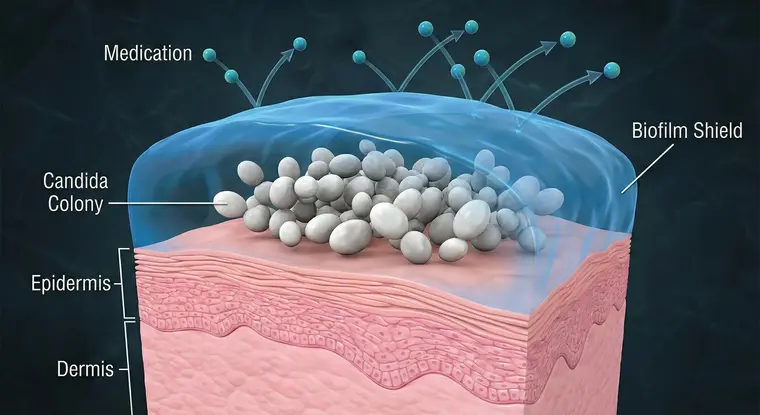
Conventional antifungals only kill free-floating fungi. But in chronic cases, Candida forms a Biofilm – a slimy fortress that adheres to the vaginal wall.
🔬 The Secret of "Sleeper Cells"
Inside this bunker, resistant cells survive. As soon as you stop the cream, they "wake up" and the infection returns. That is why you need a 3-Phase System.
The Biofilm Reset Method (3 Phases)
Phase 1: The Breakdown (Enzymatic)
We use natural enzymes (such as NAC) that liquefy the protective shield and expose the fungus.
Phase 2: The Elimination
Targeted active ingredients and nutrition eliminate the unprotected fungus and the reservoir in the gut.
Phase 3: The Restoration
Colonization with L. crispatus bacteria to physically block new infections.
Comparison: Why Creams Fail
| Criterion | Standard Creams | Biofilm Method |
|---|---|---|
| Relieves itching? | Yes | Yes |
| Dissolves the biofilm? | No | Yes |
| Gut restoration? | No | Yes |
| Lasting freedom? | Rarely | Yes |
Testimonials
⭐⭐⭐⭐⭐ Lisa M. (34): "I had a yeast infection every month for 3 years. I have now been completely symptom-free for 8 months. The knowledge about the biofilm was the key!"
⭐⭐⭐⭐⭐ Sabine K. (29): "Finally, I have control over my body again. The shopping lists are worth their weight in gold."
Are you ready to break the cycle?
Get the complete guide "The Biofilm Method" now.
- ✅ The 4-Week Masterplan
- ✅ Biofilm Breaker List (Exact dosages)
- ✅ Anti-Candida Shopping Lists
- ✅ Gut Restoration Plan
- ✅ BONUS: Emergency Guide
Introductory Price
$49 $27Frequently Asked Questions (FAQ)
Can I combine this with medication?
Yes, it is the perfect complement to prevent relapses after a course of treatment.
Do I need to buy expensive products?
No. The protocol is based on active ingredients that you can buy cheaply at the drugstore or pharmacy.
Is there a guarantee?
Yes, a 30-day money-back guarantee with no questions asked.
Scientific References

-
Chandra, J., Kuhn, D. M., Mukherjee, P. K., et al.
Biofilm formation by the fungal pathogen Candida albicans: development, architecture, and drug resistance.
Journal of Bacteriology, 183(18), 5368–5377 (2001).
https://doi.org/10.1128/JB.183.18.5368-5377.2001 -
Dinicola, S., De Grazia, S., Carlomagno, G., & Bizzarri, M.
N-acetylcysteine as powerful molecule to destroy bacterial biofilms. A systematic review.
European Review for Medical and Pharmacological Sciences, 18(19), 2942–2948 (2014).
PMID: 25339490 -
Arendrup, M. C., & Patterson, T. F.
Multidrug-Resistant Candida: Epidemiology, Molecular Mechanisms, and Treatment.
The Journal of Infectious Diseases, 216(suppl_3), S445–S451 (2017).
https://doi.org/10.1093/infdis/jix131 -
Iavazzo, C., Gkegkes, I. D., Zarkada, I. M., & Falagas, M. E.
Boric acid for recurrent vulvovaginal candidiasis: a clinical review.
Journal of Women's Health, 20(8), 1245–1255 (2011).
https://doi.org/10.1089/jwh.2010.2708 -
Superti, F.
Lactoferrin from Bovine Milk: A Protective Companion for Life.
Nutrients, 12(9), 2562 (2020).
https://doi.org/10.3390/nu12092562 -
Fasano, A.
Zonulin, regulation of tight junctions, and autoimmune diseases.
Annals of the New York Academy of Sciences, 1258(1), 25–33 (2012).
https://doi.org/10.1111/j.1749-6632.2012.06538.x -
Galley, J. D., & Bailey, M. T.
Impact of stress on the immune system and the gut microbiota.
Nature Reviews Immunology, 14, 35–37 (2014).
https://doi.org/10.1038/nri3588 -
Cohen, C. R., Waki, K., Baeten, J. M., et al.
Randomized Trial of Lactin-V to Prevent Recurrence of Bacterial Vaginosis.
The New England Journal of Medicine, 382, 1906-1915 (2020).
https://doi.org/10.1056/NEJMoa1915254